
5 Days Solo in the Lake District Autumn Photography Adventure

Autumn in the Lake District can feel like three seasons arguing over the same valley. One minute the fells glow copper and gold under golden light; the next, heavy clouds drop over the tops, rain sweeps across the lake, and the whole scene turns moody enough to make you forget your freezing hands.
That was the rhythm of this five-day solo photography trip. Early starts, wet boots, wrong turns on quiet roads, heavy skies, sudden bursts of light, and those rare, electric moments when the conditions arrived so fast I barely had time to react.
Travelling alone made the experience sharper. There was no one to negotiate with before a 5:00 AM alarm, and no distraction when a storm began to build over the ridge. Every decision led straight to the next photograph.
Day 1 in Ullswater and Honister Pass
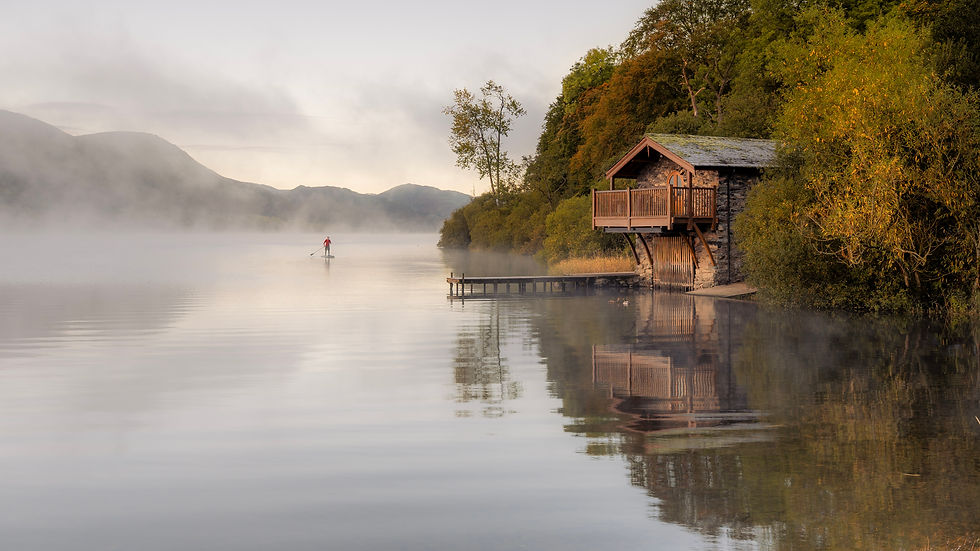
Morning: Serenity on Ullswater
The trip began before sunrise at Ullswater, wrapped in that strange stillness that only happens before the world wakes up. The lake was flat as glass, with a delicate veil of mist hovering above the surface like breath.
I had planned for a clean, peaceful composition of the classic wood and stone boathouse and its reflections. But just as I set up, a solo paddleboarder glided silently into the frame. That single human element changed everything, it gave scale to the vast lake, rhythm to the mist, and an underlying sense of quiet adventure that summed up the morning perfectly.
Field Note: With misty scenes like this, resist the urge to crank up the contrast sliders in post-processing. Push too hard and the gentle, painterly atmosphere completely evaporates. Let the shadows stay soft.
Afternoon & Evening: The Honister Pivot
By afternoon, I had driven west toward Honister Pass with one clear goal: reach Warnscale Bothy in time for last light. Tucked into the mountain side, the slate bothy blends seamlessly into its surroundings.
The trek up is steep. Factor in a heavy camera bag, rapidly shifting weather, and my usual habit of stopping every few minutes to scout compositions, and time quickly slipped away. By the time I reached the site, the sun was barely kissing the highest peaks, leaving the bothy draped in deep shadow.
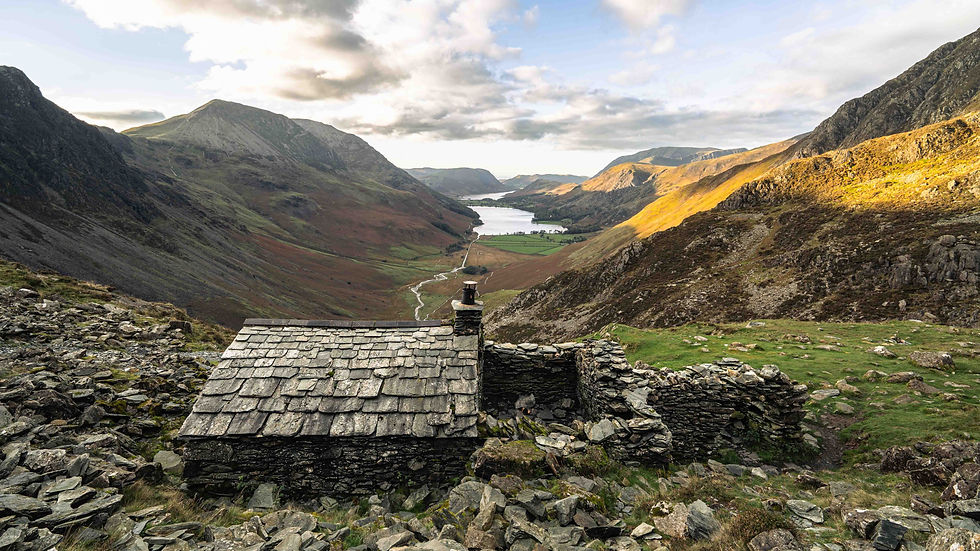
I knew I had missed the light I came for. I took a few frames to document the spot, turned back uphill, and redirected my focus toward a weather-beaten, rusted corrugated mine building near the top of the pass.
That single decision saved the evening.

Moments later, the sky caught fire in deep pinks and fiery oranges. The dark slate slopes around the pass held just enough detail, and the whole valley seemed to glow beneath the cloud cover. It wasn't the photograph I had spent hours hiking to get, it was the photograph the day offered instead.
Takeaway from Day 1: Leave room for failure in your plan. In the Lake District, missed timings are rarely wasted chances. If the light starts breaking, stop chasing the image in your head and work with the reality right in front of you.
Day 2 around Buttermere, Borrowdale, and Kelly Hall Tarn
Morning: Stripping Back Color at Buttermere
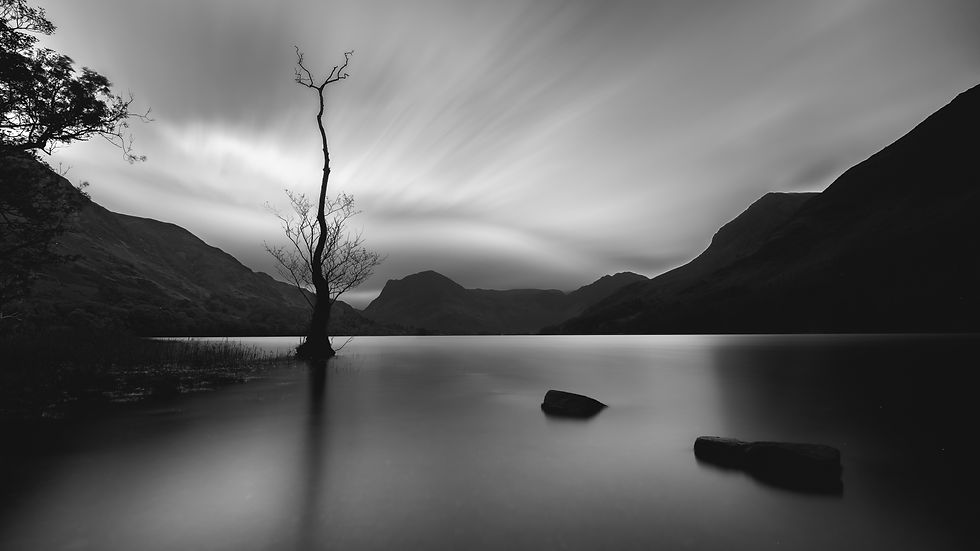
Buttermere’s lone tree is one of those classic locations that can feel almost too familiar before you even arrive. It has been photographed in every season and in every imaginable light. That does not make it any less breathtaking, but it does force you to slow down, look past the postcard, and ask what kind of image you want to create.
The morning greeted me with a muted, monochrome palette a low ceiling of heavy cloud and a gentle breeze across the water. Rather than fight against the flat conditions for color that wasn't there, I leaned into the mood and committed to a long-exposure black-and-white frame.
By extending the shutter, the tree transformed from a famous landmark into a stark, graphic silhouette pinned between smooth water, dark mountain flanks, and moving sky.
Field Note: Long exposures are your greatest tool when the light is flat. Smooth water and stretched clouds simplify a busy frame, stripping the scene down to its core elements: contrast, form, and balance.

Slowing Down: Borrowdale Mill
Later in the day, I went looking for Borrowdale Mill. Tucked away down a narrow track and shrouded by an overhanging canopy of oak and birch, it felt almost hidden from the obvious tourist routes. Places like this don't demand immediate action the way an exploding golden-hour sky does; instead, they reward patience over speed.
When you step into a damp woodland gorge, the sheer density of detail can feel overwhelming. Ancient slate walls, water-worn mossy boulders, slick timber, and cascading water all compete for attention. Rather than rushing to set up a tripod, I spent the first twenty minutes just walking around the stream, watching how the diffused woodland light picked out subtle textures on the old stone wheel.
For this shot, the key was balance. I wanted to capture both the heritage of the architecture and the natural rhythm of the beck rushing past. Using a subtle neutral density filter allowed me to drag the shutter speed down just enough to smooth out the foam without losing all texture in the water.
Field Note: In high-contrast woodland scenes, pay close attention to your bright water highlights. It’s easy to blow out the white water foam when exposing for dark mossy rocks. Underexpose slightly to preserve highlight detail, you can always gently lift the shadow tones on the stonework in post-processing.
Working at intimate locations like the mill shifts your mindset as a photographer. It’s less about chasing grand, epic scale and much more about listening to the quiet, lived-in character of the landscape.
Reflection and Precision at Kelly Hall Tarn
Kelly Hall Tarn offered a completely different kind of calm. The water held glassy, mirror-like reflections of distant mountain tops, broken only by sudden gusts of wind that skittered across the surface.

It was the sort of location where subtle micro-adjustments made an immense difference to the final frame. A few steps left or right completely altered how the fell lines intersected in the water, or whether an overhanging reed blocked a key reflection. I spent time moving the tripod an inch at a time, waiting out the ripples until the water settled into complete symmetry.
Field Note: When shooting reflections, elevation is everything. Lowering your tripod brings the foreground shoreline into prominence, while raising it pushes the mountain reflections deeper into the body of water.
Day 3 at Force Crag Mines, Whinlatter Forest, and Catbells

Cycling into the Deluge
Rain arrived with purpose on the third morning. It was the relentless, driving Lake District rain that makes you question every decision that led you to a bicycle, a heavy camera bag, and a rough gravel track heading toward Force Crag Mines.
Cycling in a downpour is far from glamorous, but covering three miles of exposed fell track on two wheels was certainly better than slogging through the mud on foot. By the time I reached the isolated mine head at the end of the valley, my gear was soaked, but the weather had gifted the site precisely the eerie, dramatic atmosphere it demanded.
Ghostly Textures & Vintage Glass
The abandoned industrial mining structures stood pale and ghostly against the towering, blackened fellside behind them. The rain blurred the distant background peaks into soft gradients of grey while leaving a wet, tactile sheen on the old stonework, rusted steel, and slate stacks.
To capture the mood, I kept compositions clean and intentionally underexposed slightly to protect the delicate highlights glistening off the wet metal and slate surfaces.

This was also the perfect scenario to lean into the tactile rendering of my kit:
Nikon Zf Color Profiles: I took advantage of the Zf's custom film simulations, utilizing a custom expired Kodachrome profile for warm earthy tones, and a Leica Monochrom-inspired preset for high-contrast, atmospheric B&Ws.
Canon FD 35mm f/2 Concave (Adapted via Z to FD): Mounting this vintage vintage lens via an adapter gave the images a distinctive, organic character. The radio-active concave front element renders fine rock micro-textures and soft, atmospheric falloff with a depth that modern clinical lenses simply cannot replicate.
Field Note: Don't let heavy rain send you packing. Industrial heritage sites, slate quarries, and ancient stone structures often look their best under dark, wet skies. The water acts as a natural polariser, deepening colors and highlighting intricate surface textures.
Whinlatter Forest: Autumn Patterns from Above
Leaving the mines behind, Whinlatter Forest brought a complete transformation in mood. The dark, monochrome fellside gave way to a living tapestry of vibrant autumn color deep pine greens, rusted bracken, golden yellow leaves, and dark timber trunks cutting clean lines through the woodland paths.
The forest felt like autumn happening at three different stages all at once: fresh foliage lingering in the sheltered canopy, falling leaves carpeting the floor, and bare branches exposing the contours of the hill.
Shifting Perspective with the Drone
When the rain finally eased and conditions allowed, I launched the drone to get above the canopy.
At ground level, the forest tracks felt like simple, winding paths. But from fifty meters up, their true character was revealed. What was a muddy trail on foot became a bold, sweeping S-curve a graphic leading line drawing the eye straight through patches of emerald pine and burning orange larch trees.
Field Note: When flying a drone over dense woodland, look for high-contrast intersection points where evergreen conifers meet deciduous trees. The color separation from above turns an ordinary forest into a striking abstract artwork.

Catbells: An Unplanned Ascent
Late in the day, as the light began to drop, I made a spontaneous decision to hike up Catbells. It was nowhere on the original itinerary which, in landscape photography, is often the single best reason to do it.
My legs were heavy and tired from hours of cycling through the rain earlier that morning, and the climb only grew more atmospheric as I gained height. There were no grand golden sunsets waiting at the top, just a thick veil of fog and heavy overcast skies wrapping around the ridge, blanketing Derwentwater below in silence.
Standing on the summit enveloped in mist, with the cold mountain air clearing my head, felt completely disconnected from the rest of the world. It was a stark reminder that you don't always need dramatic light to make a hike worthwhile; sometimes the quiet, moody fog is the reward itself.
Takeaway from Day 3: Don't stick so rigidly to your shot list that you ignore your instincts. When the weather stays dark and foggy, don't stay at home gain some elevation, embrace the atmosphere, and photograph the mood that's actually there.
Day 4 at Ashness Bridge and Hodge Close
Ashness Bridge is well known, and for good reason. It holds all the classic ingredients of the Cumbrian landscape: rustic stone, cascading water, golden autumn canopy, and distant fell views. Arriving early gave me the stillness and space needed to work before the location became busy.
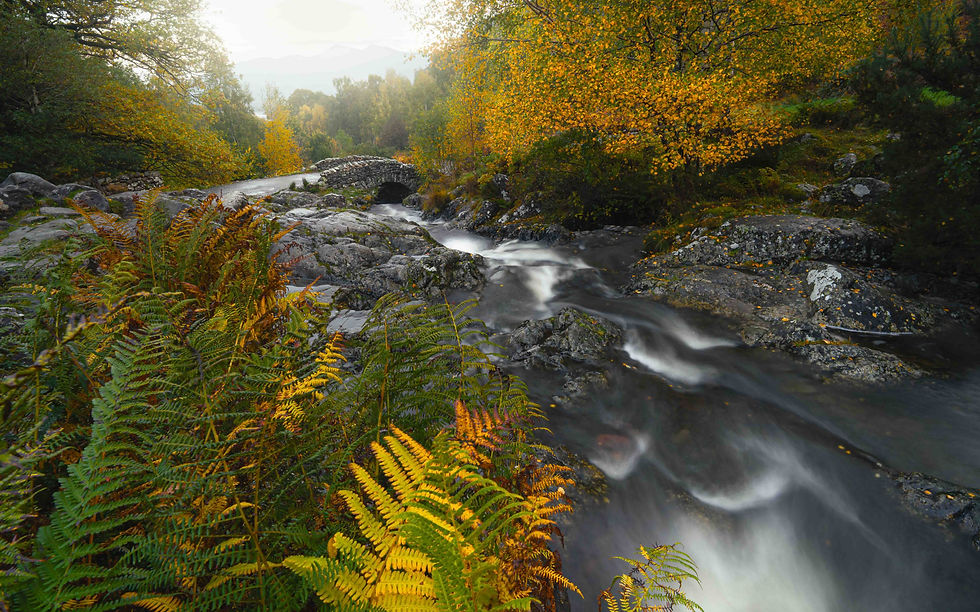
Morning: Refined Composition at Ashness Bridge
There was no direct sun breaking through the sky, but that turned out to be ideal. The flat, diffused morning light eliminated harsh shadows and hot spots on the rushing water, allowing the rich golden ferns and autumn leaves to glow naturally against the damp stone.
At famous postcard spots, the trap is rushing to shoot the obvious angle. The first frame is rarely your best. I took my time walking the bank, adjusting tripod height, and finding a composition where the bridge felt like a natural part of the wider landscape rather than just a subject slapped in the middle.
Field Note — Using a Polarizer Wisely: A circular polarizer was essential here to cut glint on wet rocks and saturate the golden ferns. However, moderation is key. Over-polarizing strips away every natural reflection, making moving water look flat and unnatural. Rotate the filter carefully until the scene feels vibrant yet completely believable.

Afternoon: The Sheer Walls of Hodge Close Quarry
Moving south to Hodge Close Quarry offered a far darker, more claustrophobic experience. After the open air of Ashness Bridge, stepping into the slate quarry felt almost surreal. Towering vertical rock walls, deep shadowed alcoves, and still, dark water gave the site an eerie, dramatic weight.

A solitary birch tree clinging to the edge of the slate cliff immediately captured my attention. It looked impossibly fragile against the relentless hard stone its pale trunk and warm autumn leaves standing out in vivid contrast against the dark, shadowed rock behind it. I intentionally framed the shot with negative space around the cliff edge to emphasize the sheer drop and amplify the tension in the scene.
Day 5 on Loughrigg Fell and the long way to Black Fell
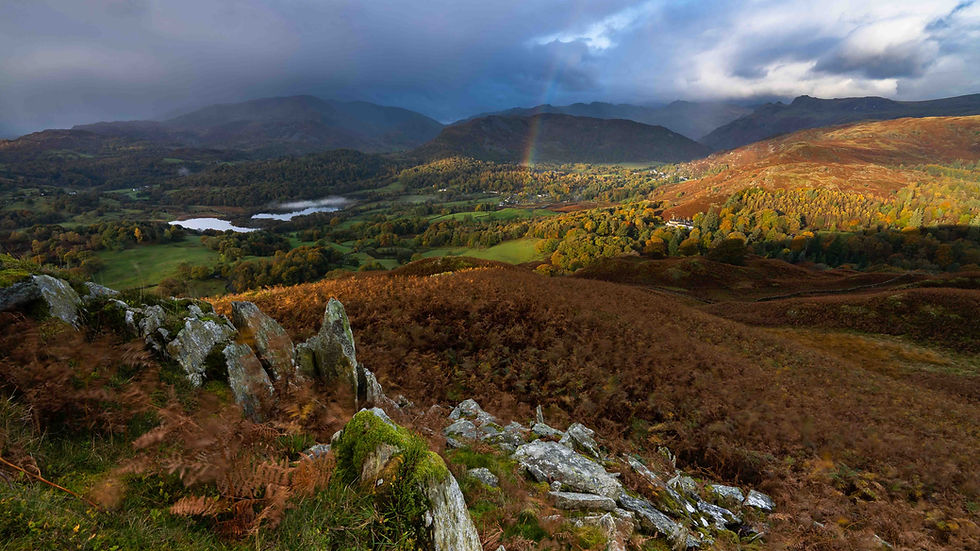
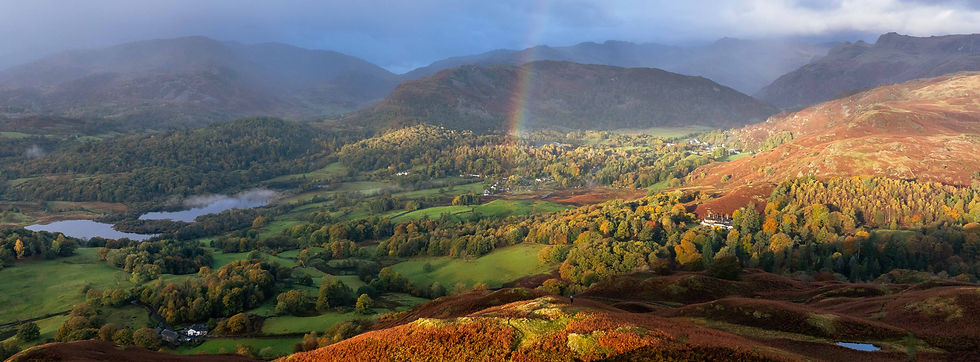
Morning: Chasing Rainbows on Loughrigg Fell
The final morning started in total darkness on the ascent up Loughrigg Fell. Pre-dawn hikes always feel like a quiet negotiation between deep physical tiredness and the sheer possibility of what might happen when the sun comes up. The path was damp, the air bitingly cold, and the pre-dawn sky gave very little away.
Then, the light arrived.
Sunrise broke across the fells, and for a brief, electric spell, the entire landscape opened up. As rain swept through the valley, a brilliant rainbow punched through the shifting sky, glowing vivid against the dark, moody hills. It was one of those fleeting, magical moments that instantly justifies every 4:00 AM alarm and freezing finger.
Field Note — Capturing Rainbows: Rainbows can be surprisingly tricky to expose correctly. They are optically bright and tend to fade the moment you panic. Expose for the highlight intensity of the arch itself, keeping the surrounding land grounded and slightly darker so the atmospheric contrast really pops.

Afternoon: The Long Way Around Black Fell
After breakfast and a quick gear reset, I headed toward Black Fell. This was the point where the day lost its elegance.
I missed a turn, corrected myself, doubted the correction, and managed to turn a straightforward walk into an improvised, wandering route across unfamiliar terrain. Getting lost while hiking alone is a strange psychological mix of frustration and razor sharp focus. For a while, the camera takes a backseat. You stop looking at compositions and start reading dry stone walls, overgrown sheep tracks, and contour lines like survival tools.
Eventually, the landscape clicked back into place, and the internal mood shifted instantly from irritation to quiet relief.

The reward was waiting quietly: one of the last standing wooden stiles straddling an ancient dry stone wall. It was weathered, simple, and rich with rural character. After days of grand mountain vistas, sweeping aerials, and dramatic waterfalls, this small, understated detail felt every bit as meaningful. I took my time framing it, using the stone wall as a natural leading line and letting the pastoral fields roll softly away behind it. It felt like a fitting full stop to the journey; quiet, practical, and deeply rooted in place.
Takeaway from Day 5: Always carry a dedicated map or offline route, even on a walk that looks simple on paper. Phone signal vanishes instantly in the fells, batteries drain twice as fast in the cold, and trails always look clearer on a screen than they do on wet ground.
Late Afternoon: The Final Stop at Blea Tarn
After descending from Black Fell, I made my way to Blea Tarn for the final shoot of the trip. Tucked in the high pass between Great Langdale and Little Langdale, it’s a location that feels almost sculpted for landscape photography, with the dramatic Langdale Pikes rising steeply across the water.

By late afternoon, the wind had completely dropped. The surface of the tarn turned into a dark glass mirror, perfectly doubling the silhouette of the crags and the scattered golden birches along the shoreline.
After five days of chasing light through driving rain, misty summits, and wrong turns, standing by the quiet edge of Blea Tarn felt deeply cathartic. I set up the tripod, carefully balanced the mountain ridge in the upper third of the frame to give the reflection room to breathe, and waited for the last light to fade behind the pikes.
It was a simple, tranquil composition no frantic weather changes, no rushing, just quiet appreciation for the landscape. The perfect final shot to close out the portfolio.

What This Solo Trip Taught Me
This was never going to be a "perfect" five-day itinerary.
I missed Warnscale Bothy at last light.
I got thoroughly soaked cycling to Force Crag Mines.
I took wrong turns and got turned around near Black Fell.
Some locations were damaged from recent storms, some were physically grueling, and many of the best frames only happened because the weather stubbornly refused to behave.
And that is precisely why the trip worked.
A landscape photography adventure in the Lake District during autumn doesn't need flawless blue skies. It needs enough flexibility to chase the light when it breaks, enough patience to sit through horizontal rain, and enough curiosity to look past the famous postcard landmarks and photograph the small, quiet details.
A few core lessons carried me through the mud and back home:
Build a framework, not a cage: Map out each day around one core location, then leave generous space for happy accidents.
Embrace the weather: Treat heavy mist and rain as atmosphere and character, not a ruined shoot.
Simplify the chaos: When woodland or mountain weather gets visually overwhelming, strip your compositions back to pure form and tone.
Shoot through the elements: Protect your gear when necessary, but never lock yourself away so tightly that you miss the action.
Safety first: When traveling solo in remote terrain, always share your route and keep your wits about you, no photograph is worth a slip on wet slate.
The Lake District in autumn is endlessly generous, but it rarely hands over its best work for free. It asks for early starts, wet boots, and a willingness to change direction at a moment's notice. In return, it gives you mist rising off still water, fiery skies over high passes, rain-darkened mines, brilliant golden forests, cliff-edge trees, and rainbows that appear precisely when you think the trip has already given everything it has to offer.
Comments